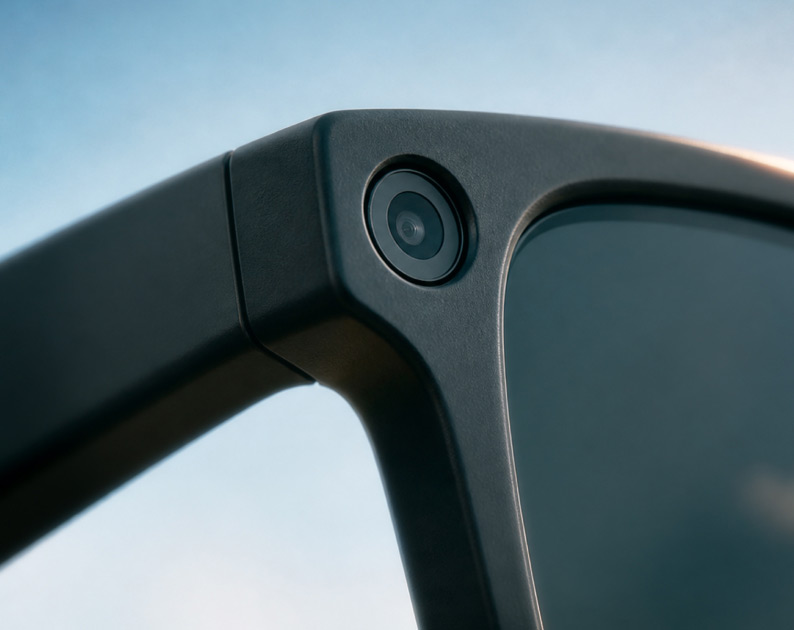
Smart glasses have become one of the fastest-moving categories in consumer electronics.
In recent months, nearly every major consumer technology company has doubled down on smart glasses:
Meta launched its new Meta Glasses collection with EssilorLuxottica.
Google unveiled Android XR eyewear partnerships with Warby Parker and Gentle Monster.
Snap introduced its latest generation of AR Specs.
Across the optical supply chain, companies like Applied Materials and EssilorLuxottica are investing in next-generation technologies designed specifically for smart glasses.
Taken together, these announcements signal something bigger than another product cycle. What was once viewed as an experimental category is rapidly evolving into a mainstream product, driven by advances in artificial intelligence, display technology and semiconductor performance.
Industry data points in the same direction. Counterpoint Research reported record shipments of augmented reality smart glasses in 2025, while Citi Research forecasts that AI glasses could reach 112 million units annually and $40 billion in market revenue by 2030.
As the market matures, expectations change. The first generation proved smart glasses could work. The next generation has to prove people want to wear them every day.
That means building products that perform everywhere people do – from bright sidewalks to shaded streets, from the office to your car. Lighting conditions constantly change throughout the day, affecting comfort, display visibility and the overall user experience.
Consumers are already familiar with photochromic lenses that darken automatically in sunlight. But smart glasses today demand something more. Instead of simply reacting to UV light, future lenses will need to intelligently adapt to changing environments while balancing glare reduction, display visibility and energy consumption.
Recent optical platform announcements from suppliers such as Applied Materials are starting to include integrated electronic dimming technologies alongside waveguides, vision correction and sensing – highlighting that adaptive light management is becoming an increasingly important part of the smart eyewear stack.
This is where dynamic glass comes in.
Miru’s dynamic glass platform uses electrochromic technology to actively manage light at the lens level, reducing glare, and improving display visibility as lighting conditions change. It transforms the lens from a passive component into an active part of the user experience.
Designed for next-generation smart eyewear, Miru’s platform is built around the requirements that matter for this market: low haze, neutral colour performance, low-voltage operation, minimal energy demand, and compatibility with light, compact and curved form factors.
The conversation around smart glasses is no longer just about AI, displays or processors. It is about creating products people can wear comfortably, naturally and confidently throughout the day.
As smart eyewear moves toward mainstream adoption, the glass will play a much bigger role.
Learn more about Miru dynamic glass here: https://mirucorp.com/industries/wearables-augmented-reality/