Miru welcomes automotive industry veteran Mike Rowe to the team
Published on
April 22, 2026
Words by
Vedika Daswani
Vancouver, Canada – April 22, 2026 – Miru Smart Technologies (“Miru”), a leading smart window technology developer, is pleased to welcome Mike Rowe to the team as the company advances toward commercial deployment of its dynamic glass technology for automotive and other emerging applications.
Mike will work across technical and commercial teams to support the deployment of Miru’s technology into automotive platforms. He brings over 20 years of experience in automotive electronics and roof systems, with leadership roles at Autoliv and Inalfa Roof Systems, where he worked directly with global OEMs to develop and launch production-ready technologies across safety systems, interior sensing, and glazing-integrated electronics.
“Mike knows what it takes to move technology from concept to production inside the automotive industry,” said Curtis Berlinguette, Founder and CEO of Miru. “He has spent his career working alongside OEMs to turn complex systems into deployable solutions. As we expand our vehicle programs, that experience is critical.”
“Miru’s approach to dynamic glazing opens up new possibilities – not just for comfort, but for how vehicles manage light, heat, and sensing”, said Mike Rowe. “I am excited to help bring this technology into production.”
As vehicles become more connected and software-defined, Miru is transforming glass into a high-performance, adaptive surface – working closely with OEMs to bring intelligent, responsive glazing into next-generation vehicles.
Media contact
Vedika Daswani
v.daswani@mirucorp.com
Mativ and Miru Expand Partnership to Accelerate eWindow Commercialization for Automotive Markets
Published on
January 14, 2026
Words by
Vedika Daswani
ALPHARETTA, Ga., [January 14, 2026] – Mativ Holdings, Inc. (NYSE: MATV), a global leader in specialty materials, today announced an equity investment into Miru Smart Technologies (“Miru”), a leading smart window technology developer, to deepen their strategic partnership and prepare Miru for commercial production of its dynamic electrochromic window (“eWindow”) technology. This investment furthers the Miru-Mativ partnership as technical validation and commercial readiness work continues, targeting vehicle platforms.
Building on a history of successful co-development through Mativ’s advanced polymer film brand Argotec, this latest agreement signals a shift toward high-volume manufacturing alignment.
Key pillars of the strengthened partnership include:
Aligned growth plans: Synchronization between Miru’s 2028 mission of deploying 10 million square feet of eWindows with Mativ’s global extrusion capacity.
Capabilities and infrastructure: Optimizing operational framework to enable commercial production and meet stringent automotive performance standards.
Supply chain resilience:Integration of Argotec’s high-performance TPU-based films into Miru’s patented manufacturing process to meet the surging demand from automotive OEMs and architectural developers.
“Mativ pioneers engineered materials designed to tackle the world’s most complex challenges through innovation and a steadfast commitment to sustainability,” said Shruti Singhal, President and CEO of Mativ. “Building on our strong 2025 performance, this investment underscores our confidence in Miru’s technology and our shared goal to establish eWindows, integrated with Argotec technology, as the global standard for energy-efficient glazing.”
“Miru’s growth reflects the work of translating breakthrough technology into a production-ready vehicle platform,” said Curtis Berlinguette, Founder and CEO of Miru. “This progress has been shaped by close collaboration with our partners, and Mativ has played an important role in that journey. With this investment, we strengthen our manufacturing capabilities and supply chain to bring the next generation of smart windows to market.”
Miru’s eWindow technology, paired with Argotec’s optically clear polymer films, delivers a unique neutral tint, superior clarity and advanced solar heat control that can extend EV range by up to 10%.
Through its partnership with Mativ – showcased at Glasstec 2024 and Glass Performance Days 2025 – these innovations are quickly evolving into scalable, manufacturable solutions for industries such as automotive, building and construction, and other industrial applications.
–
About Mativ
Mativ Holdings, Inc. is a global leader in specialty materials, solving our customers’ most complex challenges by engineering bold, innovative solutions that connect, protect and purify our world. Headquartered in Alpharetta, Georgia, we manufacture on three continents and generate sales in over 80 countries through our family of business-to-business and consumer product brands. The company’s two operating segments, Filtration & Advanced Materials and Sustainable & Adhesive Solutions, target premium applications across diversified and growing categories. Our broad portfolio of technologies combines polymers, fibers and resins to optimize the performance of our customers’ products across multiple stages of the value chain. Our leading positions are a testament to our best-in-class global manufacturing, supply chain and materials science capabilities. We drive innovation and enhance performance, finding potential in the impossible. To learn more, visit mativ.com.
About Argotec
Founded in 1988, Argotec is the global leader in engineered polymer films. Argotec provides unparalleled extrusion capability, capacity, and quality controls to support businesses across the globe. Argotec films are a critical component in a wide variety of industries, including automotive, aerospace, aviation, building & construction, medical, dental, consumer goods, graphics, renewable energy, safety & defense, and more. From surface and paint protection to smart glass and wound care, Argotec innovates everyday products. To learn more, visit argotec.com.
About Miru Smart Technologies
Miru Smart Technologies develops electrochromic windows (“eWindows”) for the automotive, transportation and architectural sectors. Miru eWindows transform static glass into dynamic, responsive systems, disrupting industry standards with high performance, aesthetic and functionality. Miru is paving the way for the next generation of energy-efficient window technologies, with the vision to enhance the well-being of people and our planet. Learn more at mirucorp.com.
Contacts
Vedika Daswani, Marketing and Communications Manager
AI: The engine accelerating Miru’s path from lab to market
Published on
November 10, 2025
Words by
Vedika Daswani
This post is the second in our series on how AI and automation are reshaping material innovation at Miru.
————————————————————————————————————————————
In 2018, Miru’s Founder and CEO, Curtis Berlinguette, helped co-pioneer a self-driving lab – an autonomous R&D platform that combined robotics, automation, and machine learning to accelerate material discovery.
Today, that same DNA powers Adam, Miru’s Self-Driving Lab (SDL), which is redefining the pace of electrochromic innovation and how new materials become manufacturable products.
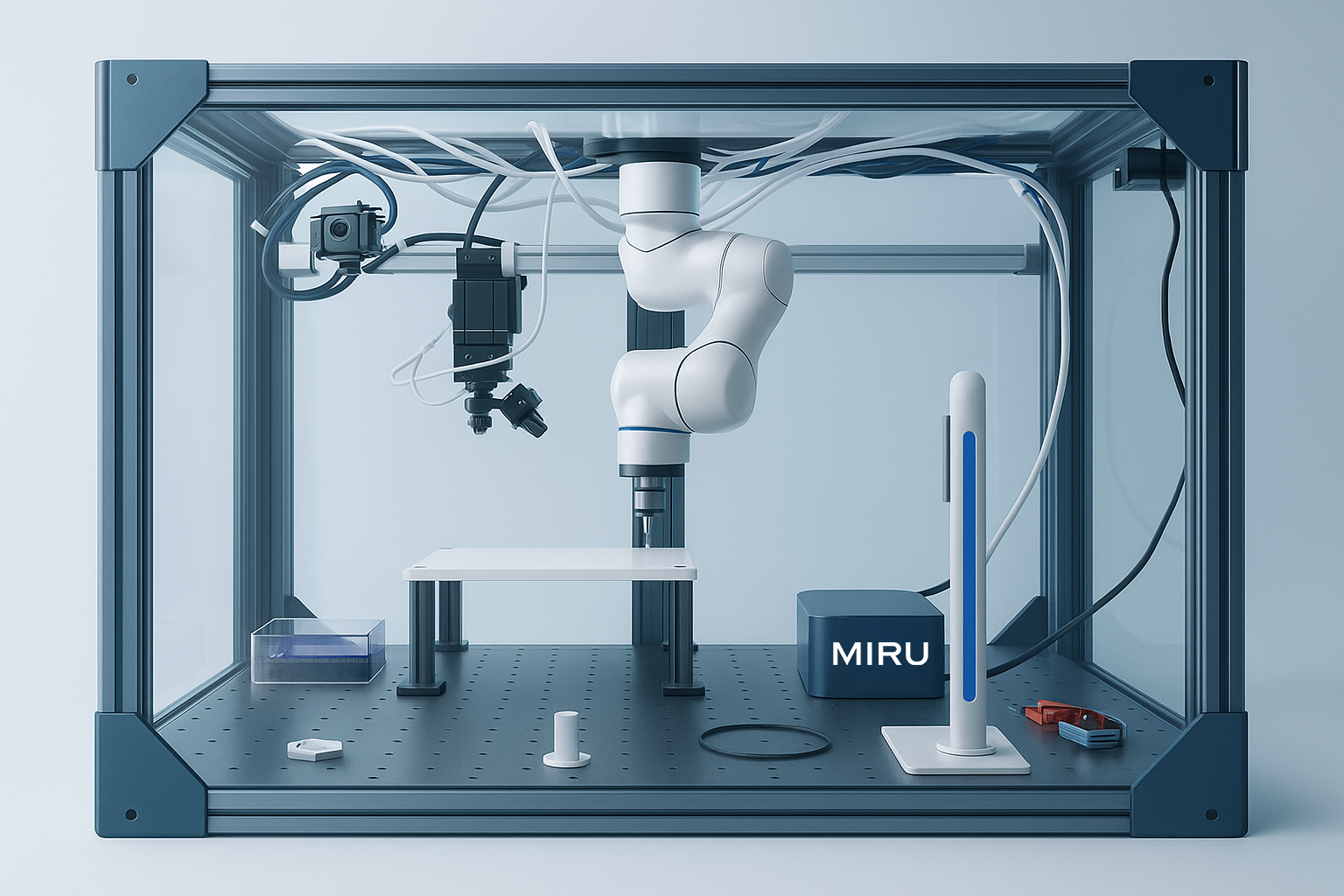
Equipped with advanced capabilities such as spray coating, solution mixing, a reactor, device imaging, and haze measurement systems, Adam can autonomously mix, deposit, cure, and analyze coatings with precision – before instantly planning and executing the next experiment.
This process compresses months of development into days. The result: Miru can rapidly discover and optimize formulations and product testing that make our dynamic electrochromic windows (“eWindows”) ready for development and scale-up.
Adam’s data-rich workflows feed directly into Miru’s product development and engineering pipelines. Each iteration teaches the system how variables – like Ink ratios, curing temperatures and deposition speeds – affect the real-world manufacturability of Miru eWindows.
That means process improvements discovered in the lab can move seamlessly from R&D to production. Every spray pattern, curing profile, and material stack is traceable, reproducible, and optimized – a foundation for consistent quality and rapid scale-up.
As Miru advances towards our mission to deploy 10 million square feet of eWindows by 2028, this digital thread between discovery and production ensures that we can scale without compromise.
Most innovations stall between the lab and the factory floor. At Miru, AI bridges that gap.


Recent Comments