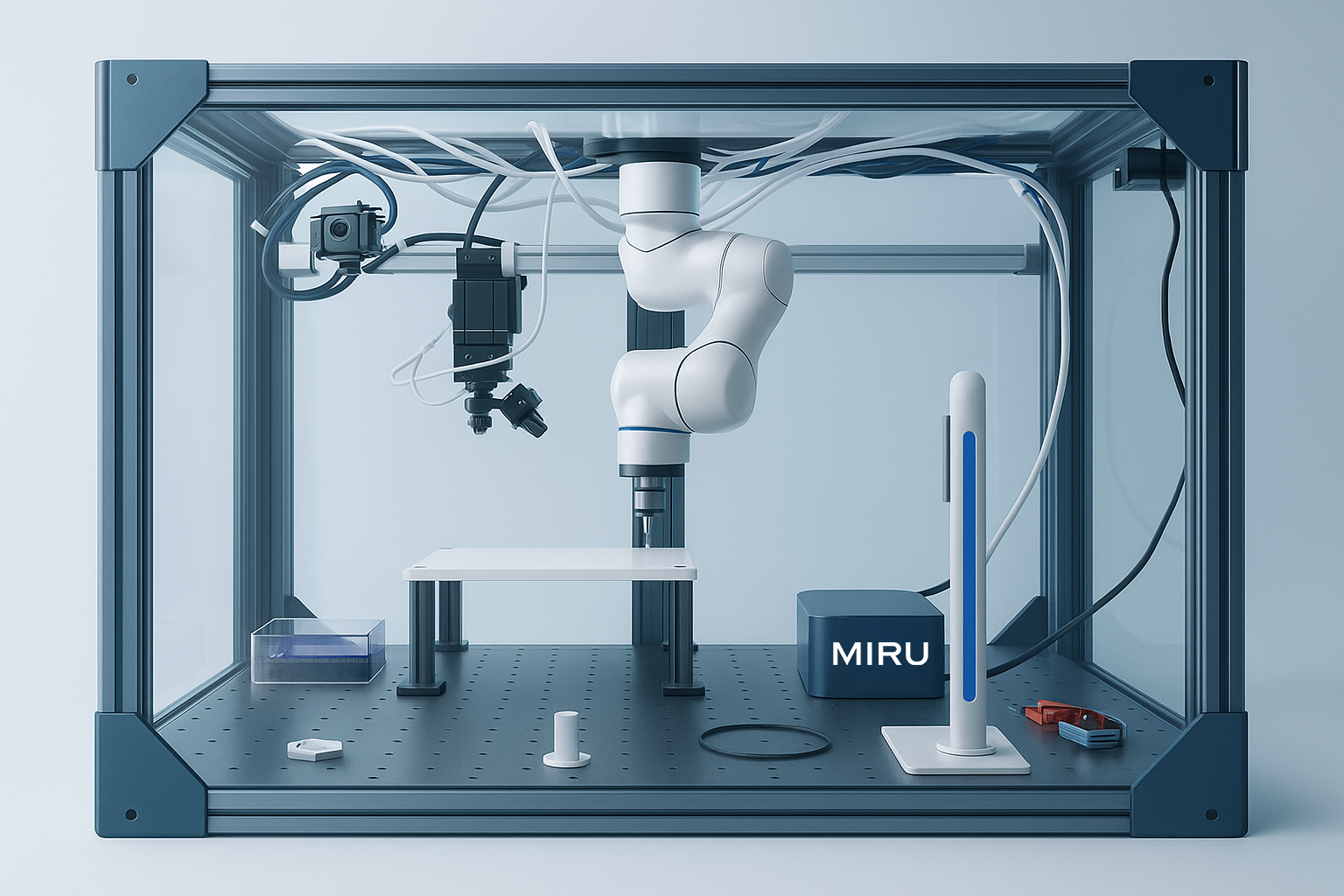
An AI rendering of Adam, Miru’s Self-driving Lab

AI: The engine accelerating Miru’s path from lab to market

This post is the second in our series on how AI and automation are reshaping material innovation at Miru. 

————————————————————————————————————————————

In 2018, Miru’s Founder and CEO, Curtis Berlinguette, helped co-pioneer a self-driving lab – an autonomous R&D platform that combined robotics, automation, and machine learning to accelerate material discovery.

[Related: Read more in Globe and Mail, Science Magazine, and related concepts featured in The New York Times.]

Today, that same DNA powers Adam, Miru’s Self-Driving Lab (SDL), which is redefining the pace of electrochromic innovation and how new materials become manufacturable products.

Equipped with advanced capabilities such as spray coating, solution mixing, a reactor, device imaging, and haze measurement systems, Adam can autonomously mix, deposit, cure, and analyze coatings with precision – before instantly planning and executing the next experiment.

This process compresses months of development into days. The result: Miru can rapidly discover and optimize formulations and product testing that make our dynamic electrochromic windows (“eWindows”) ready for development and scale-up.

Adam’s data-rich workflows feed directly into Miru’s product development and engineering pipelines. Each iteration teaches the system how variables – like Ink ratios, curing temperatures and deposition speeds – affect the real-world manufacturability of Miru eWindows.

That means process improvements discovered in the lab can move seamlessly from R&D to production. Every spray pattern, curing profile, and material stack is traceable, reproducible, and optimized – a foundation for consistent quality and rapid scale-up.

As Miru advances towards our mission to deploy 10 million square feet of eWindows by 2028, this digital thread between discovery and production ensures that we can scale without compromise. 

Most innovations stall between the lab and the factory floor. At Miru, AI bridges that gap.

– 

Read more in Part 1: Faster discovery, smarter glass: Meet Adam, Miru’s Self-Driving Lab.
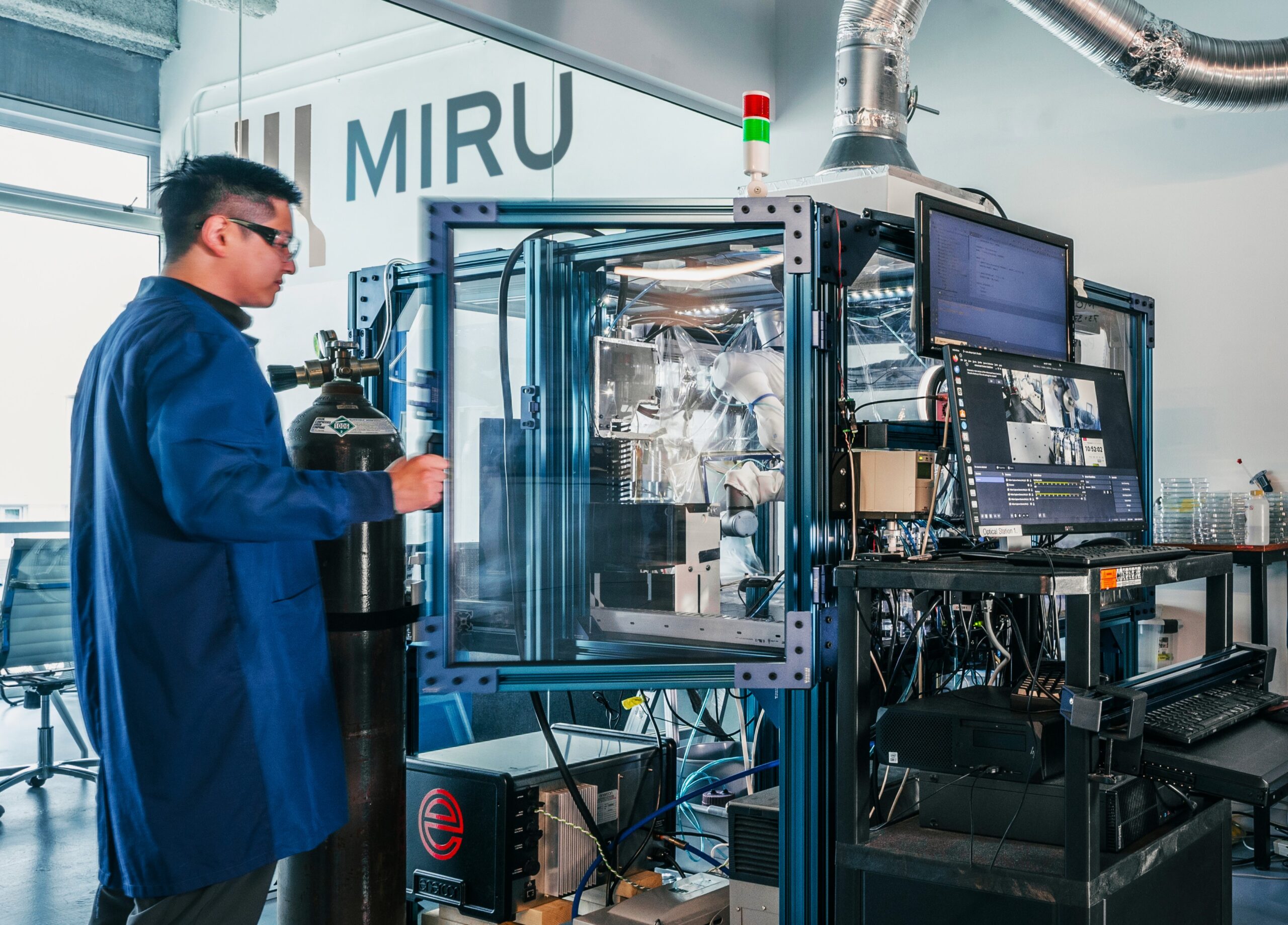
Meet Adam, Miru’s Self-Driving Lab

Faster discovery, smarter glass: Meet Adam, Miru’s Self-Driving Lab

At Miru, innovation is not just about what comes out of our lab – it is how we make the discovery itself faster, smarter, and more scalable. That is where “Adam”, our groundbreaking AI-driven robot scientist, or self-driving lab, comes in. 

Adam is accelerating how we discover and refine the advanced materials behind Miru’s dynamic electrochromic window (“eWindow”) technology. Electrochromic materials may look simple in action – tiny pulses of electricity tinting a window – but they involve millions of variables and years of iteration. Traditionally, it would take decades to move from breakthrough to market.

We decided to accelerate that timeline.

In 2018, our CEO, Curtis Berlinguette, and his team at the University of British Columbia built “Ada”, the world’s first fully autonomous self-driving labs. In collaboration with Jason Hein and Alan Aspuru-Guzik, and backed by an $8 million grant from Natural Resources Canada, Ada could mix, cast, process, test, and analyze materials – and then instantly adjust and repeat. What once took nine months could be compressed into five days.

Adam is the first generation of self-driving labs being used in the materials industry. 

(“Ada” was named after Ada Lovelace; “Adam”, is the Ada-Miru iteration.)

Faster, more powerful, and always learning, Adam runs complex experiments continuously and with frequent microadjustments, freeing Miru engineers and scientists to focus on insights and strategy. Together, human ingenuity and AI speed are pushing the boundaries of what is possible in electrochromic technology.

The result: Miru is uncovering better materials at a record pace – developing smarter, more sustainable eWindows for cars, homes, and buildings around the world.

Miru’s mission is to enhance the well-being of people and the planet. Adam is one more way we are building that future, today.

Read more here: