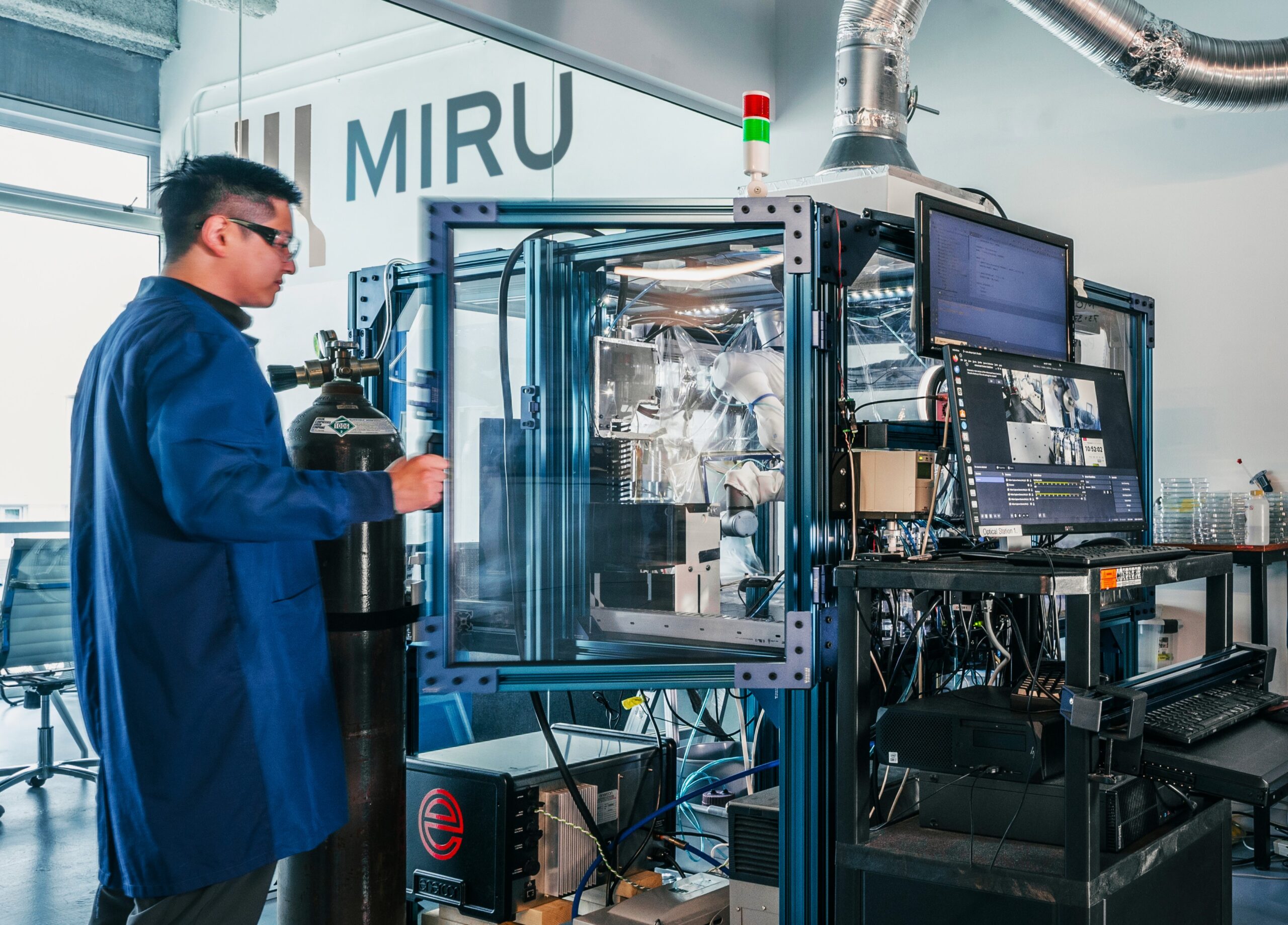
At Miru, innovation is not just about what comes out of our lab – it is how we make the discovery itself faster, smarter, and more scalable. That is where “Adam”, our groundbreaking AI-driven robot scientist, or self-driving lab, comes in.
Adam is accelerating how we discover and refine the advanced materials behind Miru’s dynamic electrochromic window (“eWindow”) technology. Electrochromic materials may look simple in action – tiny pulses of electricity tinting a window – but they involve millions of variables and years of iteration. Traditionally, it would take decades to move from breakthrough to market.
We decided to accelerate that timeline.
In 2018, our CEO, Curtis Berlinguette, and his team at the University of British Columbia built “Ada”, the world’s first fully autonomous self-driving labs. In collaboration with Jason Hein and Alan Aspuru-Guzik, and backed by an $8 million grant from Natural Resources Canada, Ada could mix, cast, process, test, and analyze materials – and then instantly adjust and repeat. What once took nine months could be compressed into five days.
Adam is the first generation of self-driving labs being used in the materials industry.
(“Ada” was named after Ada Lovelace; “Adam”, is the Ada-Miru iteration.)
Faster, more powerful, and always learning, Adam runs complex experiments continuously and with frequent microadjustments, freeing Miru engineers and scientists to focus on insights and strategy. Together, human ingenuity and AI speed are pushing the boundaries of what is possible in electrochromic technology.
The result: Miru is uncovering better materials at a record pace – developing smarter, more sustainable eWindows for cars, homes, and buildings around the world.
Miru’s mission is to enhance the well-being of people and the planet. Adam is one more way we are building that future, today.
Electric vehicles and e-bikes may be in the limelight of our global move towards decarbonization, but our buildings play an outsized role in reducing our carbon emissions.
Many people do not realize that buildings consume more energy than the entire transportation sector combined—including all cars, trucks and planes. The majority of this energy goes toward heating, cooling and lighting, which accounts for 27% of global GHG emissions and generates 10 gigatons of carbon emissions annually.
This energy goes right out the window—literally. If we can improve the energy efficiency of our windows, we can make a sizable impact in reducing global carbon emissions. At Miru Smart Technologies, we are developing proprietary electrochromic window technology that electronically tints to substantially reduce the amount of energy buildings consume.
Windows are a major source of carbon emissions
Windows are better than walls: They let in the natural light we need for our mental and physical health, and let us connect us to the outside world. But increasingly strict energy-efficiency codes are forcing builders to use more walls than windows to meet these regulations.
Unwanted heat entering or leaving through windows is responsible for 30% of space heating and cooling energy needs in buildings.
To reduce the energy our buildings consume, we need to design better windows—windows that let in natural light and views while also keeping the adequate and comfortable temperature inside.
Windows have not changed in 40 years
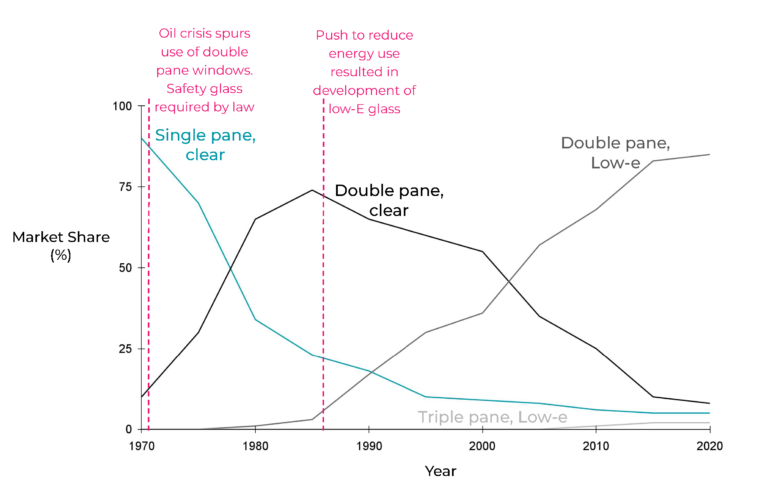
The energy crisis of the 1970s led to the development of the first low-emissivity (“low-E”) windows. These windows have a coat of thin metal film deposited onto hot float glass. They allow sunlight into a room while, depending on the climate, reflecting or keeping heat to help maintain the inside temperature to increase building energy efficiencies by 20%.
Today, 85% of windows sold around the world contain a low-E coating.
Market share by glazing type showing that low-E windows account for 85% of the global market. Figure updated from National Renewable Energy Laboratory (NREL) (2022, April). www.nrel.gov.
Low-E windows do not change with the seasons
While low-E windows make our buildings more energy efficient, they are static. The amount of light let into the windows and the amount of heat the windows reflect does not change between winter and summer, morning, midday and evening, weekdays and weekends.
Currently, when designing the building’s enclosure, a compromise is made when selecting the glazing parameters so the windows can deliver the best performance across different seasons. This compromise leaves a lot of energy on the table. Low-E windows let in too much energy during hot summers while not taking advantage of free solar energy during cold winters.
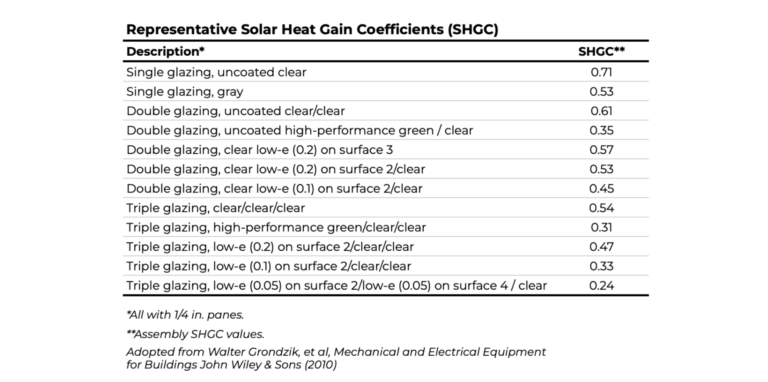
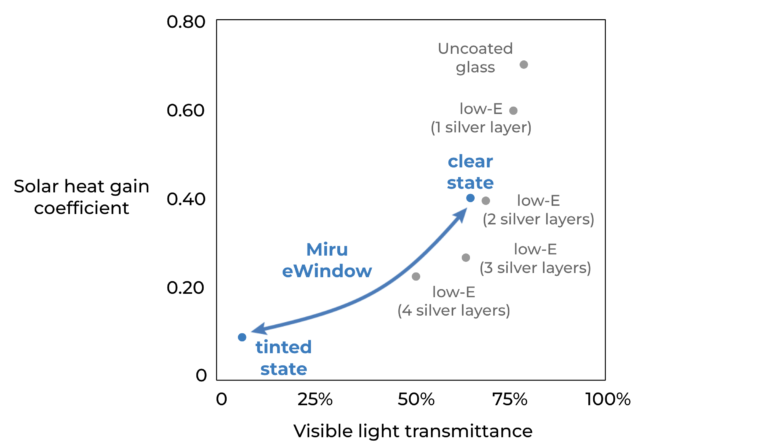
This inefficiency becomes apparent when looking at the solar heat gain coefficient (“SHGC”) of low-E windows. SHGC is a standard used to measure the insulating properties of a window. By definition, SHGC is the ratio of solar energy that hits a window and the solar energy that enters the window. A low SHGC (<0.30) is desirable when it is warm outside, while a higher value (>0.50) is preferable when it is cold outside.
For low-E windows, you need to select a single SHGC value even though the temperature the window is exposed to will vary significantly over time.
Solar heat gain coefficient (“SHGC”) values for a variety of different glazing configurations, with higher values representing the configurations that let more solar energy through the window.
How eWindows give you control of your SHGC
It is not realistic to change our window glass each season like we do with car tires. However, a window with a SHGC that changes depending on environmental conditions can provide the energy efficiency of a range of different window tints.
The variable tint available with eWindows does this.
eWindows allow you to electronically control the SHGC of the window, so you can easily toggle between different SHGCs depending on the weather, time of day, season, or building occupation.
Plot of visible light transmittance (i.e., level of tint) vs. SHGC for various glazings to demonstrate the relationship between the degree of visible light transmittance and SHGC.
How do eWindows work?
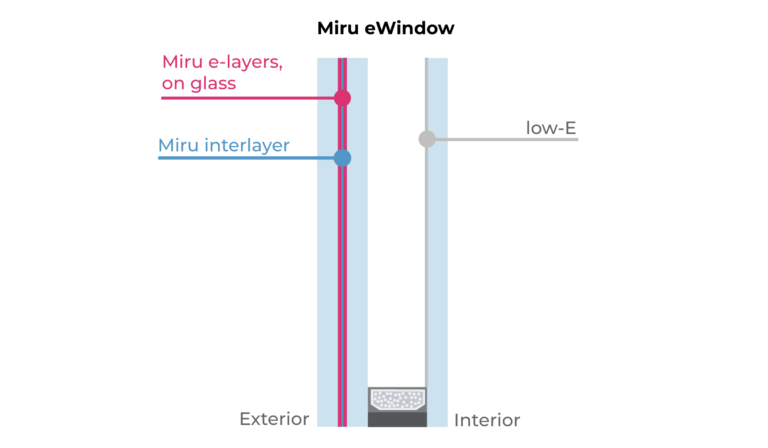
Miru eWindows use laminated electrochromic glass units that are combined into an electrochromic insulated glass unit (“eIGU”).
The electrochromic units contain two pieces of glass, each with a metal oxide coating that changes color when charge is passed through it. The electrochromic units operate like a lithium battery: electricity drives the migration of lithium from one metal oxide coating to the other. This ion migration changes the transparency of the window from a clear to tinted state. The window can be cleared again by simply reversing the direction of electrical current.
This ability to vary the tint with applied voltage gives you precise control of the eWindow’s SHGC. The window can also be connected to an algorithm or automated thermostat to change the tint of the window with the time of day or cloud cover, all while letting you enjoy your pleasant view.
Rendering of a cross-section of a Miru eIGU showing the electrochromic unit that faces the exterior of the building, and low-E glass towards the interior of the building.
How long does the energy payback take?
eWindows contain more coatings than lowE windows, so they can be a more expensive investment up front. However, the initial eWindows’ costs are offset by the smaller investment required for the heating and cooling systems of the building. In fact, eWindows can actually reduce the overall cost of a building.
More importantly, eWindows provide significant energy and carbon savings. The energy savings from eWindows yield cost and carbon payback periods of less than two years, particularly in hot climates that need to maintain cool indoor temperatures.
For example, recent industry case studies of electrochromic glazing retrofits demonstrated that a Seattle office building saved 18% in annual energy, and a shopping mall in Colorado showed an even higher 73% reduction in energy use when eWindows were combined with lighting and envelope improvements.
Eliminate gigatons of CO2 emissions with eWindows
Windows are everywhere. The inefficiency of these windows are responsible for massive amounts of carbon emissions.
eWindows are a clean energy technology that can provide significant energy and carbon savings today.
If every installed window was an eWindow, we would reduce global CO2 emissions by 2 gigatons per year. This would represent a reduction of global CO2 emissions by more than 5%! eWindows are a proven technology and can be deployed today. With the Biden administration’s 30% tax credit for eWindows in the 2022 Inflation Reduction Act, increasingly stringent energy-efficient codes, and growing stress on our power grids, there is more demand than supply for eWindows.
Policies are forcing the electrification of cities. The building industry must find ways to make their buildings more efficient and eWindows are an important part of the solution as the world moves toward a decarbonized future.
This article first appeared in Clean50 on August 18, 2023.
Miru surpasses critical milestone in durability testing
Published on
August 31, 2023
Words by
Lesel Radage
Next Generation eWindows Prove Resilient to Thermal and Solar Stresses
VANCOUVER, BC, August 31, 2023 – Miru Smart Technologies, a developer of next generation electrochromic windows (eWindows) achieved a critical testing milestone that proves the technology’s resilience to thermal and solar stresses.
Miru eWindow samples have surpassed 150,000 cycles under ambient conditions and 50,000 cycles under aggressive sun and heat testing conditions. Miru’s eWindow samples showed no degradation throughout the rigorous testing cycle. Miru’s patented electrode formulation and manufacturing process showed resilience to thermal and solar stresses—validating Miru’s system design and setting the stage for Miru to move to the commercialization phase of its manufacturing process.
The 50,000 cycle test is an accelerated version of ASTM E2141 testing conditions, with 1 Sun irradiance at 85°C and an extreme accelerated cycle time of one minute. The ASTM E2141 test is the industry standard for materials, products, systems, and services for electrochromic windows. To reach 50,000 cycles is considered to meet 50 years of operation for electrochromic windows in buildings.
“Through this intense testing, Miru has validated our eWindow technology and confirmed our key materials, system and manufacturing design considerations” said Curtis Berlinguette, Founder and CEO, Miru Smart Technologies. “This significant achievement demonstrates the reliability and durability of Miru’s technology, and underscores our commitment to delivering innovative and high-performance window solutions.”
About Miru
Miru is developing next generation eWindow solutions for the residential, commercial and automotive markets. Miru is disrupting how eWindows are produced and distributed, with a patented process that lowers costs, improves performance and significantly reduces carbon emissions—enhancing the well-being of people and our planet. Miru imagines a world where windows expand your view and keep you connected to your community and the world around you. Miru’s growth has been significantly aided by the support of the National Research Council, the BC Innovative Clean Energy (BC ICE) Fund, and the Canadian Sustainable Development Technology Fund (SDTC). Learn more at mirucorp.com.
Recent Comments