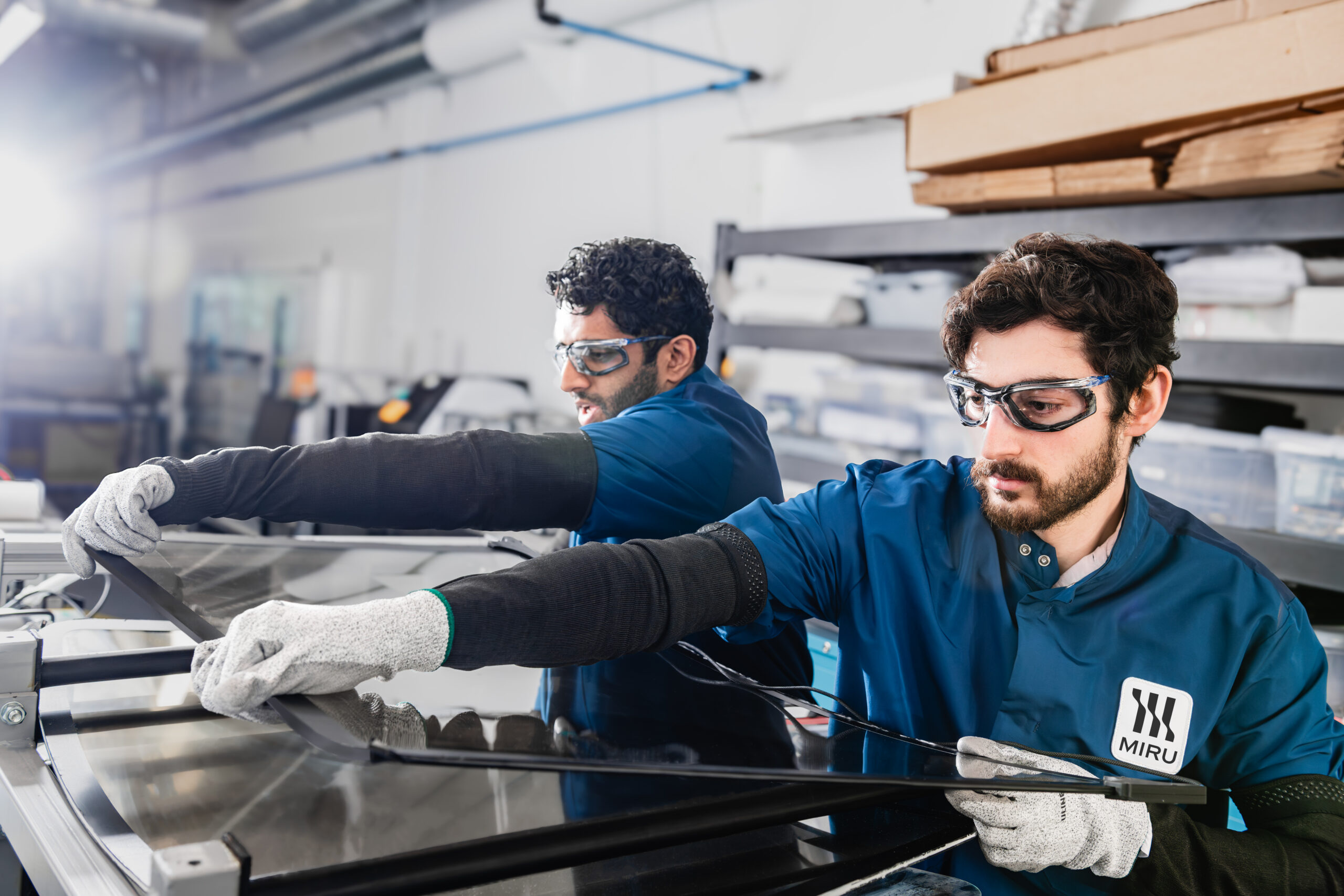
As Miru prepares to scale dynamic glass for automotive, wearables, and future optical systems, we are focused on more than developing breakthrough materials. We are also building the manufacturing technologies needed to produce them at commercial scale.
Miru recently launched a GL-AI-ZE project to explore how artificial intelligence (AI) can make advanced manufacturing more efficient, consistent, and scalable.
With support from NGen, Canada’s advanced manufacturing innovation network, the project brings together Miru’s dynamic glass technology with Mazlite’s industrial AI platform for spray and powder processes, and Innovative Finishing Solutions’ (IFS) expertise in robotic paintshop and finishing systems.
At the heart of the project is a simple idea: manufacturing should be able to adapt.
There are several ways to make a window smart. The most common approach involves applying a film to the glass that makes it responsive to light or other stimuli, but Miru’s approach is different: we spray our proprietary inks directly onto the glass for a more durable, flexible surface.
Producing Miru’s electrochromic coatings requires precise control over a complex spray coating process. Traditional manufacturing is often rigid, with a ‘set and forget’ approach. Advanced materials do not always behave in fixed ways. Small changes in the operating environment can influence how a coating is deposited, even when the equipment settings remain the same. This drift can lead to significant material waste and high defect costs.
GL-AI-ZE leverages AI to address this challenge. By applying machine learning to real-time data from the spray process , the system identifies deviations, and recommends or applies adjustments to maintain consistent coating quality. Instead of reacting to manufacturing issues after they occur, GL-AI-ZE continuously optimizes the process parameters as conditions change, creating a closed-loop AI system.
For Miru, this approach supports the next phase of our commercialization. Smarter manufacturing can improve consistency, reduce waste, increase throughput, and help scale production across a global network of manufacturing partners. The project also aligns with Miru’s broader strategy of combining advanced materials with advanced manufacturing to accelerate the adoption of dynamic glass.
The impact extends beyond Miru.
Many advanced manufacturing industries, from automotive and advanced optics to consumer electronics and precision coatings, face similar challenges as products become more sophisticated. Adaptive, AI-enabled manufacturing can improve quality, efficiency, and sustainability across these sectors.
The future of advanced materials and the future of manufacturing will evolve together. Projects like GL-AI-ZE are helping us build both.



Recent Comments