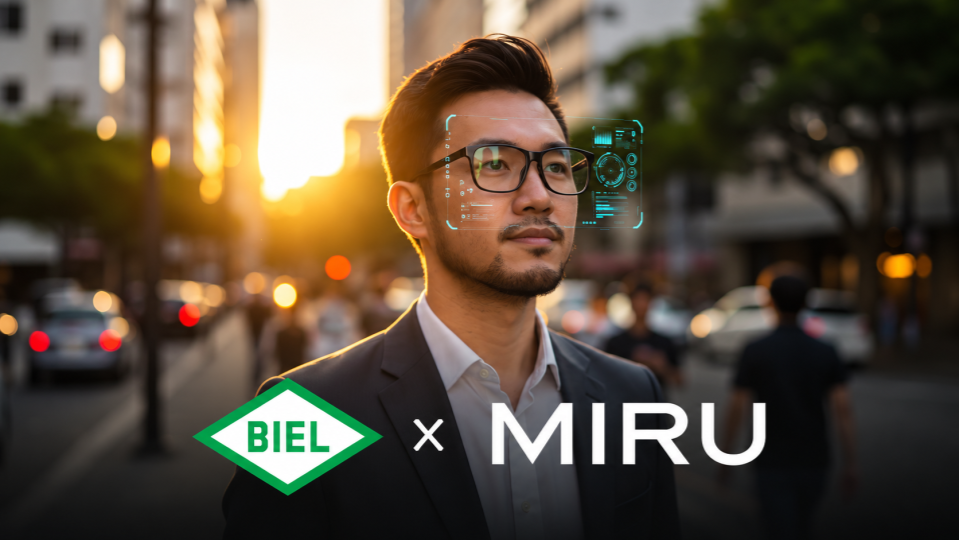
Miru and Biel partner to scale dimmable glass for augmented reality (AR) and transparent wearable displays

Miru Smart Technologies (“Miru”), a developer of dynamic glass technology, today announced a partnership with Biel Crystal Intelligent Technology Company Limited (“Biel”), a leading global provider of exterior structure and module solutions for smart devices. The companies will develop electrochromic lenses for augmented reality (AR) glasses and transparent displays and prepare them for volume manufacturing.

The partnership combines Miru’s electrochromic materials and lens design with Biel’s precision glass processing and manufacturing expertise. Miru and Biel are planning to establish a production-grade pilot line to supply lenses for customer evaluation and qualification and prepare for higher-volume production.

Bright sunlight can wash out images on transparent displays. Miru lenses electronically adjust their tint to control how much ambient light reaches the eye, helping keep digital content readable as wearers move between indoors and outdoors. Neutral color and low haze preserve a clear view of the surroundings, while low power consumption limits battery draw.

“As personal computing moves from our hands into our line of sight, the lens has to keep both the display and the world around it clear,” said Curtis Berlinguette, Founder and CEO of Miru. “With Biel, we are building the manufacturing capability to deliver that experience across millions of devices.”

“For smart glasses to work throughout the day, their displays need to stay readable as lighting changes,” said Simon Yeung, Vice President at Biel. “By combining Miru’s dynamic light control with our precision glass processing, we can give device makers dimmable lenses they can design into their next products.”

Miru and Biel are planning the line that will put dimmable lenses into the hands of device makers for qualification and lay the groundwork for producing them by the millions.

—

About Biel

Founded in 1989, Biel Crystal is a global manufacturer of precision glass components and modules for smartphones, wearables, AR and VR glasses, and vehicles. Its products include smartphone cover glass, optical glass for cameras, sapphire watch covers, and touch and fingerprint sensor modules. Learn more at bielcrystal.com.

About Miru Smart Technologies

Miru Smart Technologies is advancing how devices and vehicles see and interact with the world. Its dynamic electrochromic glass electronically controls light, heat, and glare, enhancing clarity in augmented reality (AR) and wearable displays, supporting robotic vision, and improving comfort and energy-efficiency in vehicles and buildings. Headquartered in Vancouver, BC, Canada, Miru combines advanced proprietary materials with manufacturing expertise to enable partners to bring dynamic glass into everyday applications. Learn more at mirucorp.com.

Media contact

Sharn Sodhi 
s.sodhi@mirucorp.com

Building the future of adaptive manufacturing

Case study: Building the future of adaptive manufacturing

As Miru prepares to scale dynamic glass for automotive, wearables, and future optical systems, we are focused on more than developing breakthrough materials. We are also building the manufacturing technologies needed to produce them at commercial scale.

Miru recently launched a GL-AI-ZE project to explore how artificial intelligence (AI) can make advanced manufacturing more efficient, consistent, and scalable. 

With support from NGen, Canada’s advanced manufacturing innovation network, the project brings together Miru’s dynamic glass technology with Mazlite’s industrial AI platform for spray and powder processes, and Innovative Finishing Solutions’ (IFS) expertise in robotic paintshop and finishing systems.

At the heart of the project is a simple idea: manufacturing should be able to adapt.

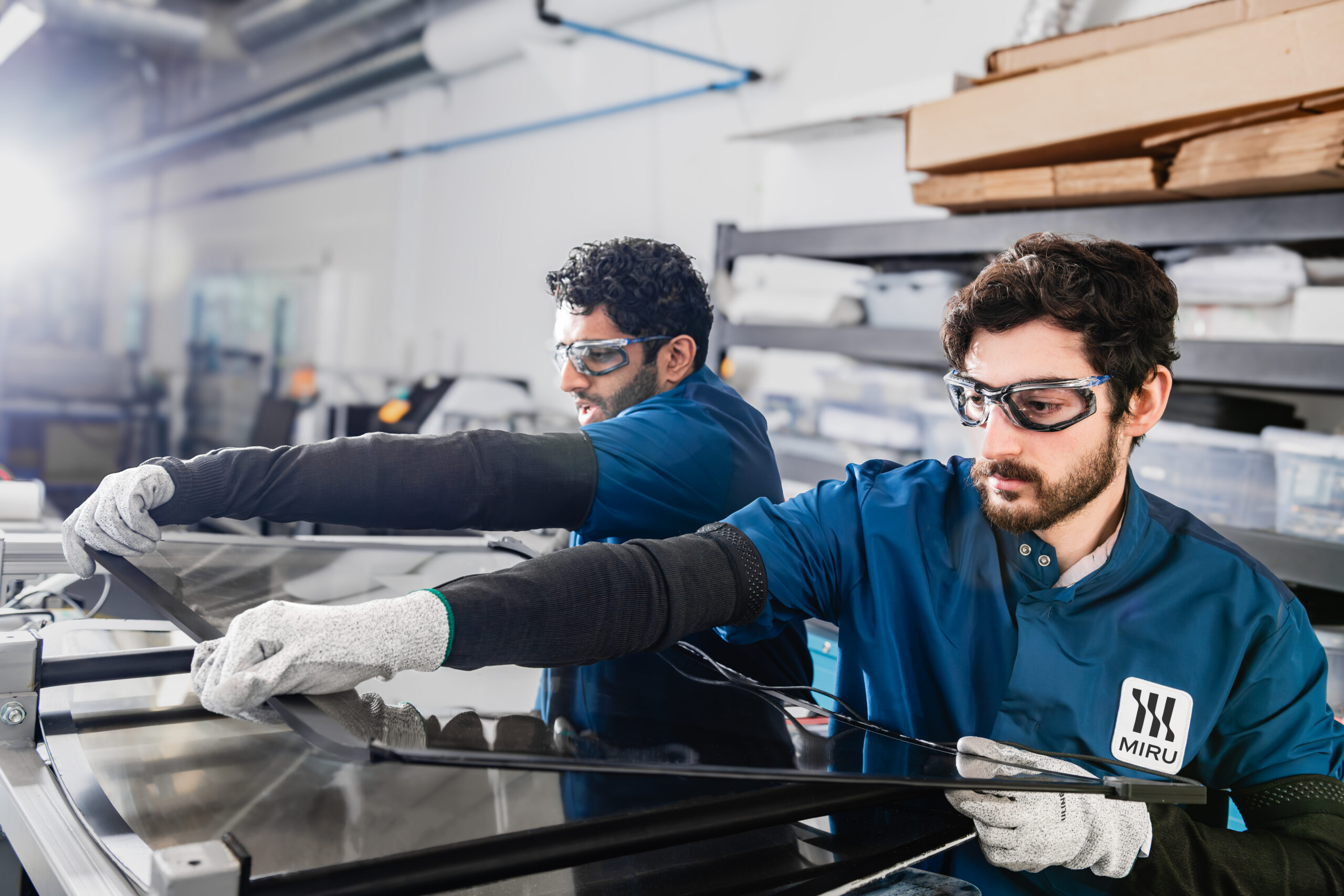
There are several ways to make a window smart. The most common approach involves applying a film to the glass that makes it responsive to light or other stimuli, but Miru’s approach is different: we spray our proprietary inks directly onto the glass for a more durable, flexible surface.

Producing Miru’s electrochromic coatings requires precise control over a complex spray coating process. Traditional manufacturing is often rigid, with a ‘set and forget’ approach. Advanced materials do not always behave in fixed ways. Small changes in the operating environment can influence how a coating is deposited, even when the equipment settings remain the same. This drift can lead to significant material waste and high defect costs.

GL-AI-ZE leverages AI to address this challenge. By applying machine learning to real-time data from the spray process , the system identifies deviations, and recommends or applies adjustments to maintain consistent coating quality. Instead of reacting to manufacturing issues after they occur, GL-AI-ZE continuously optimizes the process parameters as conditions change, creating a closed-loop AI system. 

For Miru, this approach supports the next phase of our commercialization. Smarter manufacturing can improve consistency, reduce waste, increase throughput, and help scale production across a global network of manufacturing partners. The project also aligns with Miru’s broader strategy of combining advanced materials with advanced manufacturing to accelerate the adoption of dynamic glass.

The impact extends beyond Miru. 

Many advanced manufacturing industries, from automotive and advanced optics to consumer electronics and precision coatings, face similar challenges as products become more sophisticated. Adaptive, AI-enabled manufacturing can improve quality, efficiency, and sustainability across these sectors.

The future of advanced materials and the future of manufacturing will evolve together. Projects like GL-AI-ZE are helping us build both.